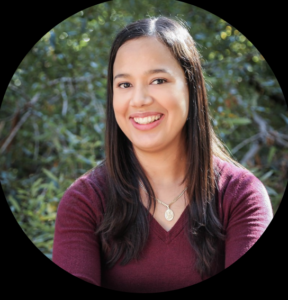
When Nitzia Mendoza began her college journey, she carried not only her own ambitions, but also the responsibility of supporting her family while navigating higher education as a first-generation college student. Financial pressure, full-time work, and academic demands often made the path feel overwhelming—but with the support of The Peninsula College Fund (PCF), Nitzia found the guidance she needed to persist.
Matched with a PCF mentor and supported by founder Charles Schmuck, Nitzia found trusted voices during moments of doubt. With parents who were Spanish speakers and limited access to college resources, she relied on PCF to help her navigate cultural barriers and critical decisions. When she was ready to give up, Charles showed up at her home and asked one simple question: How can I help? That moment proved pivotal.
Nitzia went on to earn her degree from Cal State East Bay in 2018, majoring in Health Science with an emphasis in Community Health. After graduation, she built a career in the medical field, supporting transplant patients at Lucile Packard Children’s Hospital and later serving as a resource coordinator at UCSF, helping adult cancer patients access lodging, transportation, and essential care.
Reflecting on her journey, Nitzia offers this advice to today’s scholars:
“Ask for help. Use the resources around you. Take care of your physical and mental health. You’re not alone—that’s what PCF is for.”
Nitzia’s story reflects the lasting impact of mentorship, persistence, and community—and what’s possible when students are supported every step of the way.
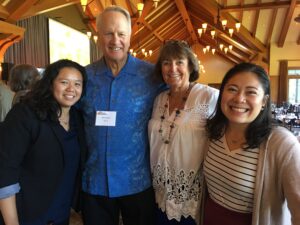
When Marisol Gomez graduated from East Palo Alto High School, her future was uncertain. As an immigrant, first-generation college student, and undocumented young woman with no financial resources, the dream of attending college seemed out of reach. But in 2005, her path changed when she was selected by The Peninsula College Fund (PCF) and founder Charles Schmuck to become one of the organization’s first three scholars.
Matched with mentor Kathy Hawkes, Marisol quickly found more than academic guidance—she found family. Kathy’s parents, Mike and Julie Hawkes, also embraced Marisol, offering encouragement, life advice, and the steady support she needed to stay on track through college. “They helped me access resources, guided me through challenges, and provided a sense of belonging I didn’t know I needed,” Marisol recalls.
Marisol went on to graduate from the University of California, Santa Cruz with a B.A. in Feminist Studies, focusing on Law, Politics, and Social Change. She later earned her Master of Public Health (MPH) from the University of San Francisco, with a concentration in Community & Public Health Practice.
Today, Marisol is a self-employed entrepreneur and co-producer of “Your Amigas Podcast,” a space she created with partners to build community among women who share similar life experiences. Her passion for helping others—rooted in the kindness she received through PCF and the Hawkes family—continues to drive her work.
Reflecting on her journey, Marisol offers this advice to current scholars:
“It’s hard—it’s not easy. But your drive, that’s your ancestors. You are living their wildest dreams.”
Marisol’s story is a testament to what’s possible when opportunity meets determination—and to the power of mentorship, community, and giving back.
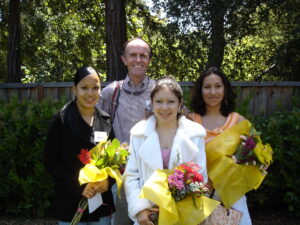
As we celebrate 20 years of The Peninsula College Fund (PCF), we are proud to honor one of our very first scholars, Miriam Noriega, who joined PCF in 2005 as one of just three students in our inaugural cohort.
Miriam attended Eastside College Prep before enrolling at Mills College in Oakland, where she majored in Women’s Studies and Spanish Literature. She was paired with PCF mentor Phil, whose support played a pivotal role in helping Miriam secure summer internships, including working as a coordinator at Castilleja, where she supported middle school girls for summers and in after-school programs.
After earning her degree, Miriam built a career in the nonprofit and social justice sector, dedicated to uplifting communities and expanding opportunities for others. Her journey came full circle when she later became a mentor to a PCF scholar, continuing the cycle of support that she once benefitted from.
Miriam also played an instrumental role in shaping PCF during its early years. She recalls the lifelong commitment of Charles and Phil, who not only guided her personally but also invited her to help build PCF’s programs and share her perspective as one of the organization’s first scholars. She later went on to serve on PCF’s Board of Directors, ensuring that future generations of students could access the same opportunities she did.
Reflecting on her experience, Miriam offers this advice to today’s first-generation college students:
Miriam’s story is a powerful reminder of PCF’s mission and the ripple effect of support, mentorship, and opportunity. From our first class of three scholars to more than 725 served today, Miriam embodies the impact of 20 years of investing in first-generation college students.
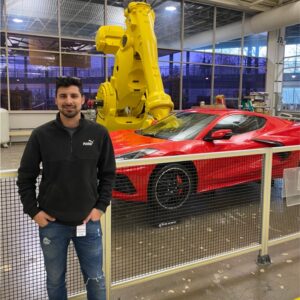
When Rogelio looks back at the path that led him to a career as a mechanical engineer at Tesla, he sees more than academic milestones or job titles. He sees a story shaped by resilience, discipline, and community—one that began long before he ever stepped onto a college campus.
A First-Generation Dream
Rogelio was born in California but moved to Mexico with his family when he was just one year old. He spent the next 14 years immersed in Mexican culture, learning Spanish and growing up in a close-knit family. Eventually, a clear goal began to form: he wanted to be the first in his family to earn a college degree—specifically in engineering.
That dream was deeply personal. Rogelio’s father worked as a mechanic, and watching him fix cars and understand how machines worked sparked Rogelio’s early fascination with engineering. “I was always intrigued by what he did,” Rogelio recalls. “How things worked, how machines worked—that really stayed with me.”
Returning to the United States to pursue education wasn’t just a personal step forward; it was about paving the way for future generations of his family. Being a first-generation college student, to Rogelio, meant opportunity, responsibility, and the promise of a better life—not only for himself, but for those who would come after him.
Navigating the Unknown at UCR
Rogelio attended UC Riverside as a first-generation student, a journey filled with excitement but also uncertainty. “The biggest challenge was not knowing what to expect,” he shares. Without family members who had gone through college or corporate careers, every decision—from class planning to career preparation—felt high stakes.
Questions like Which classes should I take? Will this delay my graduation? How do I prepare for life after college? weighed heavily on him. As graduation approached, the uncertainty intensified. “School had been my main focus for years,” he says. “Suddenly I was asking myself, what comes next?”
Despite those challenges, Rogelio learned quickly—often through trial and error—and developed the diligence and self-awareness that would later define his professional success.
From Freshman Year to Tesla
As a freshman, Rogelio always knew he wanted to be an engineer, but the path wasn’t straightforward. He began college as an electrical engineering major but soon realized his passion lay in mechanical engineering. Making that switch required determination, additional coursework, and an extra year in school—an especially daunting decision while relying on financial aid.
“It took me a full year to switch majors,” Rogelio explains. “But I never gave up.” Looking back, he’s grateful for that younger version of himself—the one who was willing to fight for his goals, even when the process was difficult and uncertain.
That perseverance paid off. Rogelio completed his degree, added a minor in business, and secured internships that ultimately led him to Tesla. Today, he sees his career as the result of those early decisions to stay focused and resilient.
The Role of PCF
Rogelio is quick to say that he wouldn’t be where he is today without PCF. “Frankly speaking, I don’t think I would’ve made it without them,” he says.
Several aspects of PCF made a lasting impact, but mentorship stood out most. His mentor, Eric, guided him through college both academically and personally. As a former physics major who went on to become an executive at HP, Eric served as both an advisor and a source of inspiration. “He helped me think before making decisions,” Rogelio says. “College didn’t feel as difficult because I wasn’t navigating it alone.”
Career development support was another game-changer. Working closely with Denise from the PCF career development team, Rogelio refined his resume, strengthened his interview skills, and learned how to approach companies with confidence. Denise ultimately helped connect him with a Tesla manager—leading to Rogelio’s first internship and, eventually, his full-time role.
A Mentor’s Lesson That Lasted
One moment with his mentor stands out vividly. During Rogelio’s sophomore year, after he had successfully transitioned into mechanical engineering, he began to ease up academically. “Eric was down in San Diego at the time, and after our conversation over the phone he understood that this was a pivotal moment in my career. I had told him how happy I was to have finished the hard part; getting into mechanical engineering. I think that specific sentence is why he made the 3 hour drive up to see me.”
The two took a walk through the Botanical Garden, where Eric delivered an honest message: engineering demands discipline—and college is only the beginning. He emphasized the importance of focus, consistency, and fully engaging with challenging material.
“That conversation stuck with me,” Rogelio says. “Discipline is critical—not just in school, but in your career and life.” Today, Rogelio applies that lesson daily in his work, using discipline and organization to lead projects efficiently and build trust with his team.
What PCF Means Today
Now a graduate and professional, Rogelio may live far from campus—having relocated for work in Texas and later Chicago—but he still feels deeply connected to the PCF community. Reading PCF emails and hearing scholars’ stories reminds him of where he started and why the program matters.
“The people at PCF feel like family,” he says. “I understand how big this journey is for students who are just starting out.” Seeing new scholars walk the same path fills him with pride and hope.
Advice to Current Scholars
For current PCF scholars, Rogelio offers heartfelt advice:
And don’t forget to have fun. “College is a unique time,” Rogelio adds. “Meet people, build friendships, and enjoy the journey.”
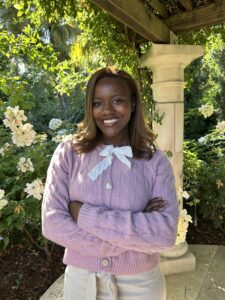
When Malika Reed started college at UC Merced in 2022, she carried both excitement and uncertainty. As a first-generation student, she wanted to thrive—but wasn’t always sure how to make that happen.
“I often asked myself, ‘Can I do this? Is it really achievable?’ Those questions stayed in the back of my mind as I faced new opportunities and challenges.”
Like many college students navigating new environments, Malika faced difficult moments early on.
“After a rough start my freshman year, the confidence I had built in high school began to fade. I even started calling myself a bad luck charm or a jinx because it felt like I had to overcome so many tribulations, while others seemed to breeze through college without problems. But that’s where PCF came in. This program gave me the support I didn’t even realize I needed and helped me rebuild my confidence, reminding me that yes—I can do it.”
Through The Peninsula College Fund’s community of support and mentorship, Malika discovered new meaning in persistence and belonging.
“By my sophomore year, I attended PCF’s annual conference, where a presenter spoke about what it means to be a ‘trailblazer.’ At first, I didn’t think that word applied to me. But I came to learn that trailblazers are people who persist through challenges, bring new perspectives, and open paths for others. Slowly, I began to see myself in that definition—with the help of PCF.”
Malika also found deep inspiration and friendship in her mentor, Sunny, whose name perfectly reflects her warmth and positivity.
“She truly lives up to her name—every time I talk to her or see her, she brightens my day. Sunny has always been there for me, no matter how many times I call or text her about what’s going on in my life. Even when she’s busy, she takes the time to listen and encourage me. That encouragement—from her and from the PCF community—has changed the course of my college years.”
Now approaching graduation, Malika reflects on the power of having a supportive village and a belief in herself.
“As I near the finish line of my undergraduate journey, I can look back and see how much I’ve grown—not just because of my own determination, but because of the village around me: my mentor, PCF, and my family. With PCF behind me, I know I will never be alone.”
She leaves a message for fellow first-generation students and young trailblazers:
“To my fellow trailblazers: as someone who has had to prove herself wrong time and time again—whether it’s making new friends, finding new opportunities, or simply finding her way—I want to remind you: never limit yourself. You will always have a village behind you, whether you realize it or not. If I can do it, so can anyone who feels like the odds are against them.”
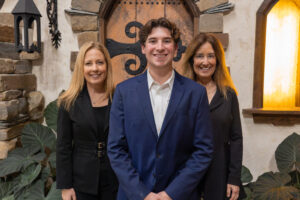
Meet Joey, a third-year undergraduate student at San Diego State University and a proud Peninsula College Fund (PCF) scholar. For Joey, the path to success is built on four crucial pillars: identity development, emotional support, professional development, and financial security. His story is a powerful testament to how PCF’s support in these areas has helped him defy statistics and rewrite the narrative for foster youth.
“There’s a stigma around foster youth,” Joey begins, “about how they act and what they are able to achieve.” Joey’s early life was marked by instability. Lacking the support systems many children take for granted, he entered the foster care system at age four before being raised in a guardianship from age six.
This experience left a deep impact. “Summer going into my senior year of high school, I really didn’t know who I was,” he recalls. “I lacked understanding of myself, emotional intelligence, and what I stood for. All of this manifested itself into extreme anxiety that I have spent the past three years unraveling.” This fear and uncertainty followed him into his first year of college, where he was terrified to take risks.
This is where PCF stepped in, providing a comprehensive support system that changed everything.
Emotional Support: Joey was paired with his mentor, Dory. “Knowing that Dory is unconditionally there for me has given me an extreme sense of security,” he shares. “Although Dory will say she has not done much, just her being there has pushed me to take risks that I otherwise would have overthought.”
Identity Development: Before PCF, Joey had never connected with other students who shared his background. A PCF event his senior year was a turning point, giving him a sense of community and preparing him to join the Guardian Scholars program for former foster youth at SDSU.
Financial Security: “Growing up, I had a really poor relationship with money,” Joey admits. The scholarship from PCF was transformative. It lifted a significant financial burden, allowing him to focus on what college is for: academics and self-growth.
Empowered by the secure foundation PCF helped him build, Joey began to take risks. He learned to see failure not as an endpoint, but as an opportunity to grow.
He ran for student government his freshman year and lost. Undeterred, he ran again for a more senior position his sophomore year, speaking to over 5,000 students. Though he lost again, he refused to be discouraged.
This newfound resilience and willingness to take chances also led to incredible successes:
Joey’s journey is a powerful reminder of the impact of investing in potential.
“Throughout my college career, I have often heard, ‘Joey, you don’t need to re-write the wheel, just repeat what’s successful.’ And I think… where the hell is the fun in that?” he asks.
“So, to all the full-time and part-time staff, mentors, volunteers, donors, and everyone else that puts any time into keeping this organization running, thank you. Thank you for investing in individuals that traditionalists would often pass up. I hope we can all look around and realize the beauty in rewriting the wheel and ending the stigma around foster youth.”




The Peninsula College Fund is a 501 (c)(3) tax exempt organization, Federal Tax ID: 26-4293269